Till leftovers do us part

We often race one another clearing the table after dinner. It’s not an overt race with running shoes, numbers strapped to our chests and the crack of a starting pistol, but a low-key, passive-aggressive run-walk type race.

I move toward the sink with a dish holding the scattered remains of a lone chicken enchilada. He pulls back his chair; I quicken my pace. Just as I am about to dump the enchilada remains into the disposal, he reaches from behind, catches the remains midair in a small plastic box and seals the lid.

“You weren’t going to throw that away, were you?” he asks.

“Of course not.  I was just holding it over a running garbage disposal to toy with it, sadist that I am.”

He delivers the enchilada remains to the refrigerator, where they are welcomed by other small containers holding 15 kernels of corn, three broccoli florets, 2 tablespoons of brown rice, five wilted spinach leaves and half of a dried and aging lemon smothered in plastic wrap.
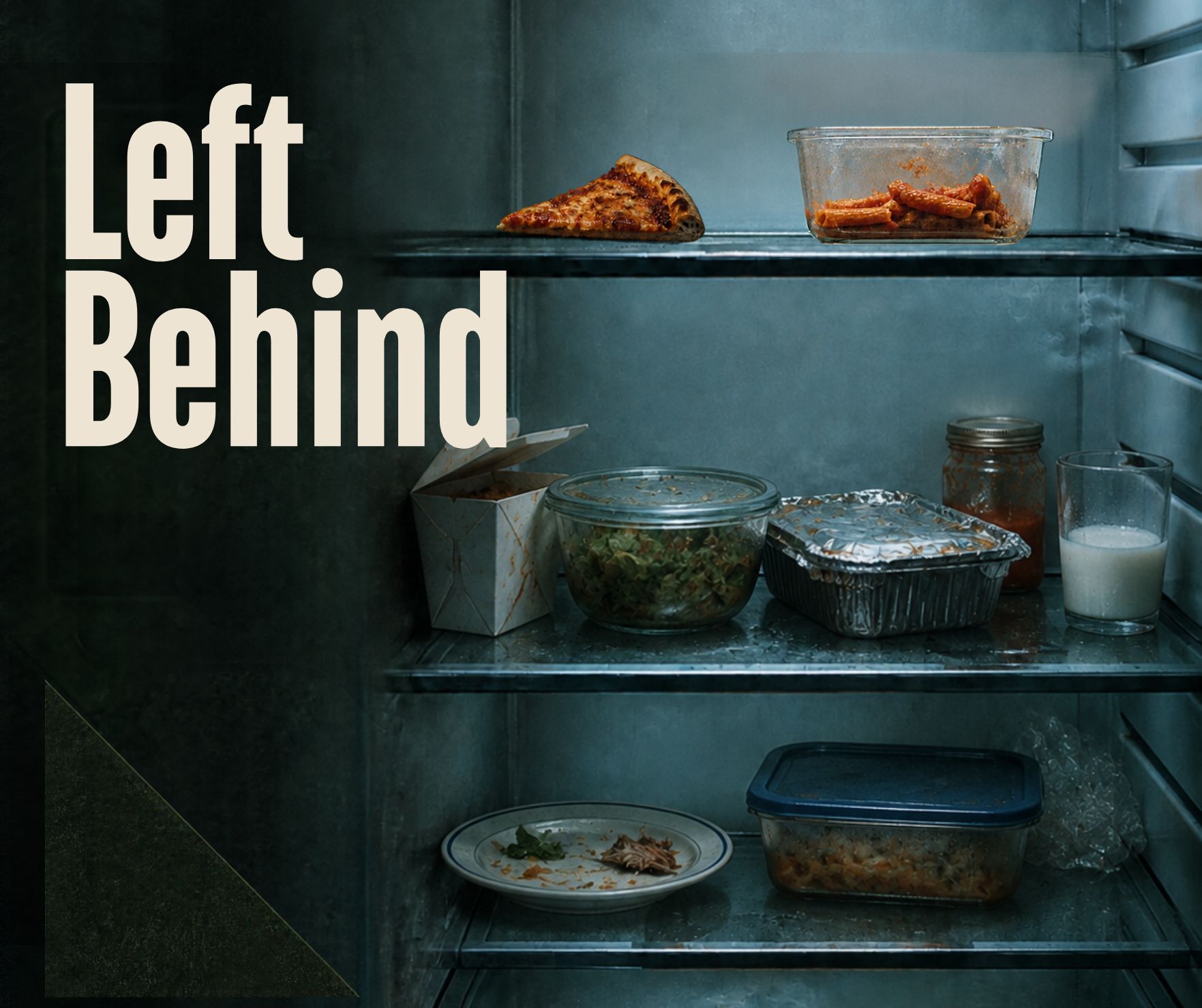
You’d think the man grew up food deprived. He did not. Their family refrigerator absolutely bulged. With leftovers. It was said no one had reached the back of that refrigerator in decades, where there were rumored to be leftovers dating back to when Neil Armstrong and Buzz Aldrin walked on the moon.

All that to say, the Tupperware doesn’t fall far from the tree.

At our house, no food dies before its time. Some never die at all; they simply fossilize and petrify. Many of the small containers ease into a slow rotation with other abandoned leftovers.

As the chicken enchilada takes center stage, aging spinach moves to the side, pushing browning celery sticks in a baggie to the back, leaving a dish holding something growing blue fur sandwiched between an expired carton of half-and-half and an aging jar of kalamata olives. Checkmate.

The husband will eat anything set before him and never complain, even if he doesn’t like it. He would have made a great pioneer heading west on a wagon train, living on dried meat, day after day and week after week.

Because the man does not believe food is capable of going bad, there are some questions I never ask him, such as: Does this smell rotten to you? Do you think that white fuzz is normal? Any guess how old this salmon is?

Last week, he brought home a slice of pizza from our daughter’s house because he thought she was going to throw it out. Seven days and counting. Four more days and it will be genuine leather.

Share This:

Confessions of an ambidextrous driver

Could someone please explain how a person sitting in the front seat of a vehicle can be labeled a backseat driver? A backseat driver would be someone in the back seat.

Fortunately, a specific label is of little concern to me as I am ambidextrous and can direct from either the front or the back.

My husband is a lucky guy. I remind him all the time.

That said, my driving and directing tips are often seen as unnecessary, as in gasping. Yes, I sometimes inhale sharply, but usually only when it appears we may miss our exit.

Hitting my imaginary brake is also unwelcome. Guilty as charged, but sometimes my right leg spasms and smacks the floorboard in front of me. This most often happens when vehicles in front of us slam on their brakes in rapid succession.

Holding out my arms as if bracing for impact is also frowned upon. I prefer to call that move “front-seat tai chi.” I’m just exercising. There’s no need to take it personally.

I work hard at not being a backseat driver. I know what it’s like to be the driver and have someone (male voice) in the passenger seat (co-owner of the vehicle) telling me where to turn, or which lane to be in, so I try not to do that to others.


Case in point — I keep a stress ball in the glove box. I picked up this tip from one of our daughters who has inherited my front- and backseat ambidextrous gift for directing. It’s a genetic condition most often passed from mothers to daughters.

There have been times I have squeezed the stress ball so tightly that my fingernails have cut through the stress ball and into the palm of my hand. At least it feels that way.

Backseat drivers are nothing new. When you look at illustrations of wagon trains heading west, what do you notice? That’s right, there are two people on the spring seat on the front of the wagon. A man is holding the reins, and a woman is beside him giving directions.

And why is it that Lewis and Clark are never referred to as Clark and Lewis? Because Lewis was in the front seat of the canoe and Clark was in the back seat giving directions.

The husband asks how it is that he has driven many times without me in the car and never had an accident.

“Funny you should ask that,” I said. “I’ve asked myself the same thing.”

Share This:

The problem with you, me and we

I blame Merriam-Webster. They define “we” as a plural pronoun when everybody knows “we” most often means another person in the room.

For example, we are eating a stuffed crust pizza and I say, “We need to watch what we eat,” meaning my better-half might want to lighten up on the late-night ice cream.

“We” is most often a subtle way of one person telling another person what to do.When the husband says, “We should go back to Maine next year,” that means he’d like me to plan a trip. “We” is how ones lobs the ball onto the other side of the court.

“We really should plan a trip to Maine,” I say, which is me returning the serve. Score: 1-1 and nobody has taken the initiative on planning a trip.

All that said, there really are times when we do things together. Case in point, “we” recently cleaned the gutters.  I stood at the bottom of the ladder as a safety measure and he teetered at the top of the ladder, reaching and stretching to scoop out wet heavy gunk and heave it into a trash can below.

Misuse of “we” can happen in any number of situations. When the doctor suggested I take a vitamin supplement, I asked why that would be necessary. He smiled and said, “You know, as we get older. . .” The man is 40, 42 tops. Unless he has a mouse in his pocket, there’s no “we” getting older. I am the one in the room getting older. That said, nice try, I appreciated his sensitivity.

Trying on clothes in a department store, a helpful clerk asks, “Would we like to try that on in a different size?” This is very confusing, as there is no one else in the dressing room and at no time will the clerk and I simultaneously try on the same article of clothing.

Misuse of the word “we” can be traced back to kindergarten when the teacher would say, “Now class, we need to roll our mats out on the floor for rest time.” I always kept one eye open during rest time and not once did the teacher roll out a mat on the floor and take a short nap.

I hope we have cleared up this matter once and for all.

Share This:

Head, shoulders knees and woes

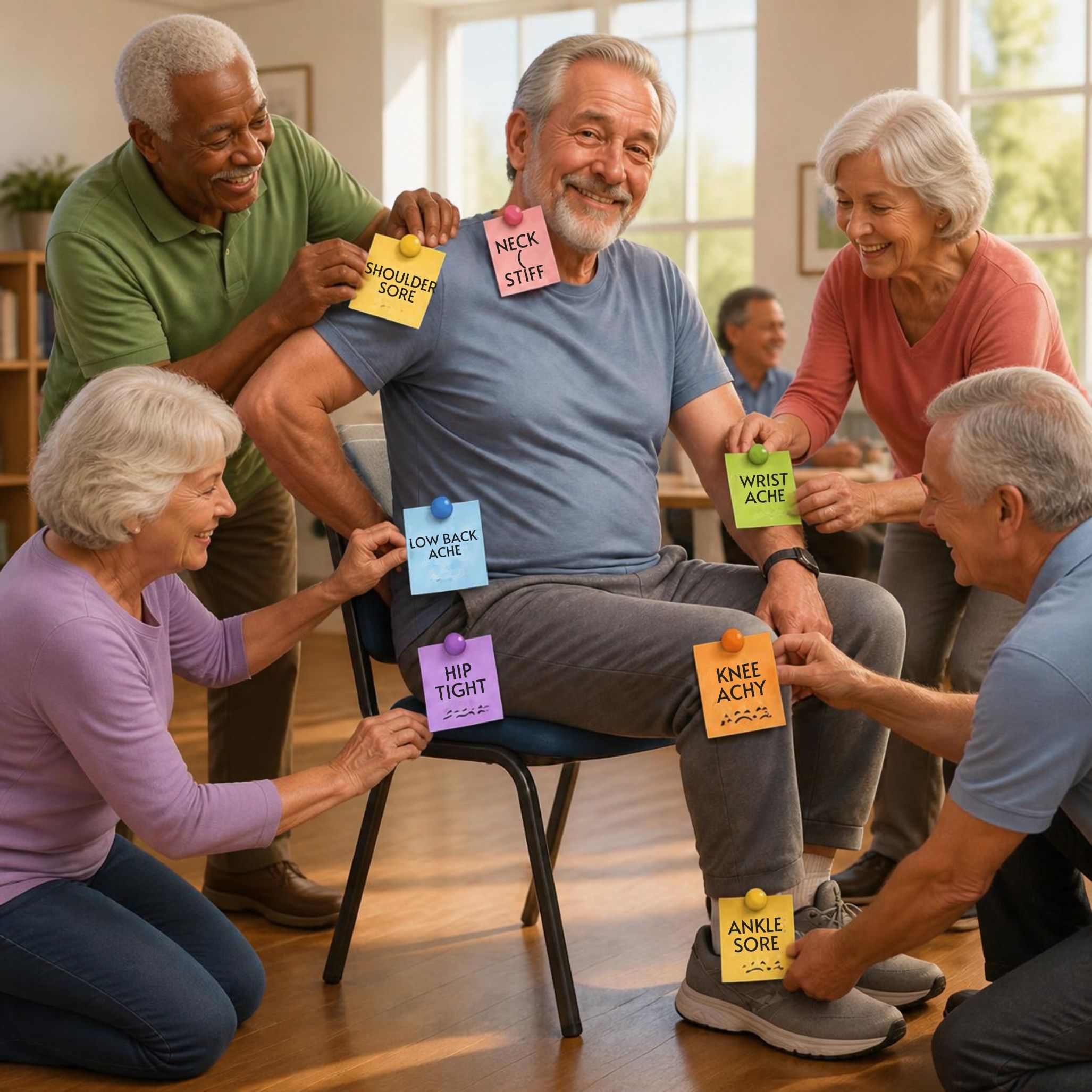
I have come to the conclusion that aging is simply a different version of Pin the Tail on the Donkey, only this one is Pin the Aches and Pains on the Old People. In Pin the Tail on the Donkey there is only one winner, but in this game everybody wins. No matter where you put the pin, you’ll tag something.

More and more, when we are together with friends our age and older, the conversation frequently turns to health matters. The conversations quickly become rounds of “Can You Top This?”

Someone announces a new knee problem, and someone else shouts, “Had that when I was 50!”

Someone reveals they are scheduled for shoulder surgery, and someone else shouts that they’ve already had two. Comparing aches and pains can be a highly competitive sport. Unfortunately, there are no ribbons, trophies or all-expenses-paid trips to beautiful islands.

The husband enjoys these conversations, as he considers them free medical advice. When I asked what he planned on doing about a knee issue he’s contended with for months, he said he’d know more next week after he talked to our friend Kathy. She’s been treated for the same issue multiple times and is undergoing treatment again. Who needs a consult with an ortho doc when you have Kathy?

A while back, a woman who sits two rows in front of us at church had a knee replacement. Six months after that, a woman who sits one row in front of us had a knee replacement. Knee replacements aren’t contagious, but all the same, I moved to the back row. At this age, I’m not taking chances.

Sometimes the conversations concerning health matters are so intense that I want to lead an impromptu round of “Head, Shoulders, Knees and Toes,” just to see who’s still agile. Of course, that would lead to a lot of snap, crackle and pop, more technically known as Rice Krispies Syndrome.

It’s important to stay positive and make the best of every situation. Case in point is a friend who says his bones may ache, but he’s getting pretty good at predicting the weather.

Among our friends are those contending with vision issues, joints that pop like bubble wrap, hearing challenges and decrease in overall speed and flexibility. Thank goodness we can all still drive.

Share This: